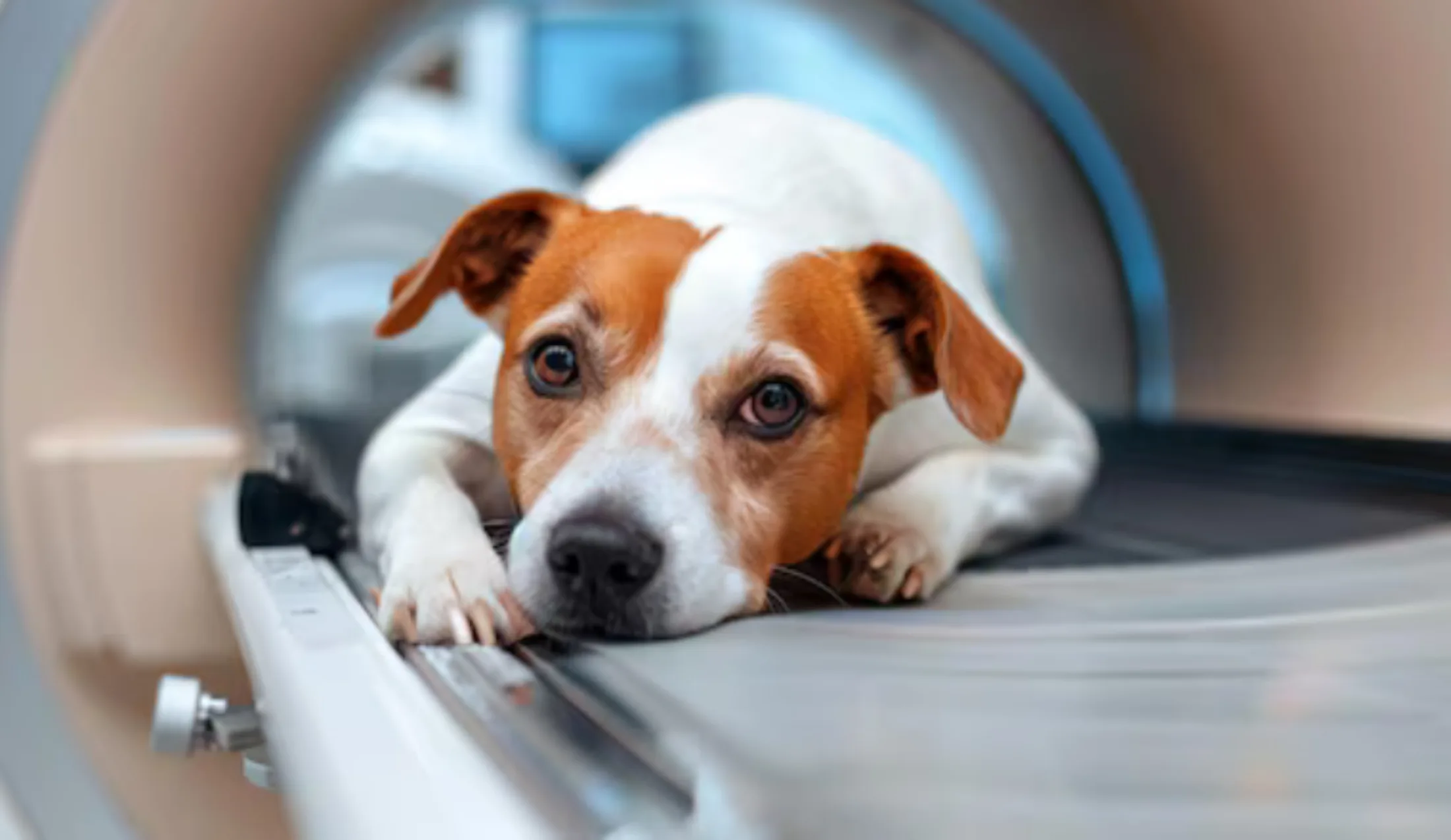
MRI in pets - Safe and detailed neurological examination
An MRI (Magnetic Resonance Imaging) is an advanced imaging technique that uses magnetic fields and radio waves to create detailed images of soft tissue. In dogs and cats, MRI is primarily used for neurological problems, such as conditions affecting the brain and spinal cord, but also for orthopedic and soft tissue issues.
In this article, we discuss how an MRI works, when it is used, and what risks are associated with it.
What is an MRI?
MRI uses strong magnetic fields and radio waves to generate images of soft tissue. Unlike X-rays or CT scans, no radiation is used. This makes MRI particularly well suited for the brain, spinal cord, nerves, muscles, and joints.
When is an MRI used?
MRI is used in dogs and cats in a variety of situations, such as:
- Investigation of seizures or epilepsy
- Suspected spinal cord compression due to a herniated disc
- Detection of spinal cord and brain tumors
- Diagnosis of inflammation or infections of the nervous system
- Assessment of joint and tendon problems
- Complex orthopedic issues
How does an MRI work?
For an MRI, the animal must lie completely still. For this reason, it is always performed under general anesthesia. The animal is placed on a special table that slides into the MRI scanner. The procedure usually takes 45 to 90 minutes. Contrast fluid is often administered to make abnormalities more visible.
Is an MRI harmful?
An MRI does not use X-ray radiation and is completely safe for dogs and cats. The magnetic field itself does not cause any harm to the animal. Only animals with metal implants or pacemakers may sometimes be unable to undergo an MRI, depending on the type of implant.
Risks and precautions
The main risks associated with an MRI scan are:
- The use of anesthesia or sedation (a small risk, closely monitored by the anesthesia team and always taking the patient's physical status into account (ASA class))
- Possible allergic reaction to contrast fluid (very rare)
Recovery after an MRI
After the MRI, the animal wakes up calmly from anesthesia. Most dogs and cats recover quickly and can go home the same day. Any mild drowsiness or nausea caused by the anesthesia usually disappears within a few hours.
Want to know more?
Read more about our services in diagnostic imaging and neurology. Our specialized veterinarians at Nesto have extensive experience with MRI diagnostics and guide you and your pet through the entire process, from examination to treatment.
Frequently asked questions (FAQ)
What is an MRI?
An advanced imaging technique that uses magnetic fields to visualize soft tissue in detail.
Does my pet need anesthesia?
Yes, anesthesia is necessary to keep the animal completely still during the scan.
Is MRI dangerous?
No, MRI does not use radiation and is completely safe. The main risk comes from the anesthesia (thanks to careful monitoring, this risk is limited).
Is contrast fluid always used?
Usually, yes, except when it poses a risk to the patient (kidney disease or a previous allergic reaction).
How long does an MRI take?
On average, 45 to 90 minutes, depending on the area being examined.

Nesto
Share on